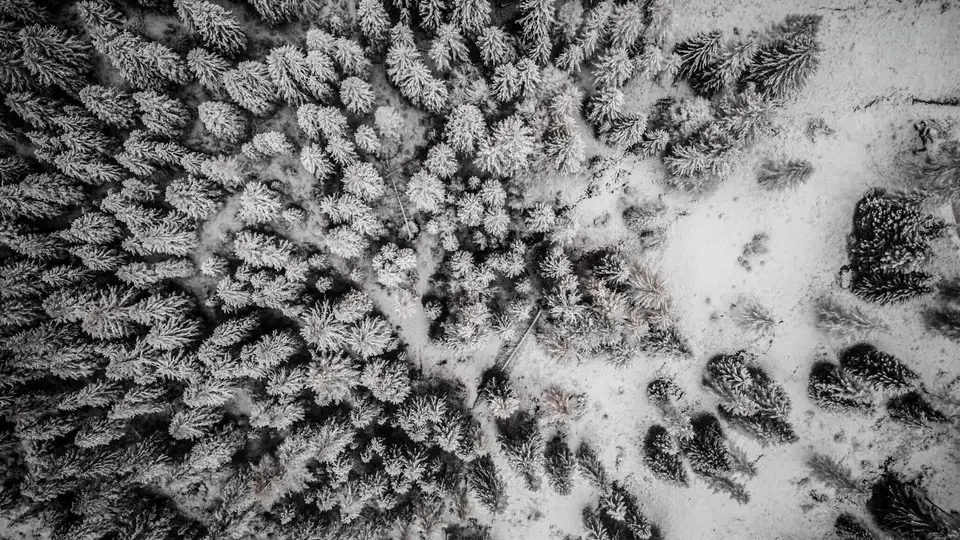
Snow-covered woods in the Dolomites.
Winter is perhaps the most complicated season for going to the mountains. Snow can make even the simplest hikes difficult, and it is never easy to predict exactly how much snow you will find on the route, at what altitude, and whether it will be packed or not. Bear in mind too that even if a mountain looks bare from a distance, a tiny shaded hollow can hide a gully full of snow.
Going on snowshoes is not easy either. You need to know which routes are packed and which are not, at what altitude the snow starts, and so on.
Perhaps our advice, in winter, is to accept that you will inevitably find some snow or ice even at low altitude. Rather than snowshoes, which are only really needed in deep, soft snow (a tiring condition for walking anyway, even with snowshoes), we recommend buying light microspikes, which give your boots grip without weighing down your pack.
Looking for Lapland conditions, with clear skies and trees laden with snow? For that you need to go to the mountains immediately after a heavy snowfall, when the snow has cleared the skies of humidity and pollution. After just a couple of hours of sun, most of the snow falls from the trees, so the window for those magazine shots is very short.
If instead you are looking for a hike with a mountain hut, bear in mind that alpine huts usually open from June to September, but some of the most popular or easily reached huts also open on winter weekends. It is always best to phone before setting off, or to check the hut's website.
In this section we have gathered some hikes that suit the winter months, either because they are at low altitude or because they work well on snowshoes.
The usual advice: warm clothes, gloves and a hat, microspikes for safety, and a close eye on the weather forecast. In winter more than ever.
Bulletins, transceivers and daylight
Before any outing on snow, the document to read is the avalanche bulletin: in Italy it is published by the regional services coordinated by AINEVA, in Switzerland by the SLF institute, and all of them use the same five-level European scale, from low to very high. Beyond the danger level, the bulletin names the most critical elevations and aspects, and that is the most useful information for choosing where to go and, above all, where not to. The walks on this page are low partly to stay clear of this kind of assessment, but a heavy snowfall can bring the problem even to the quietest paths.
In Italy there is also a legal requirement. Legislative Decree 40 of 2021, in article 26, obliges anyone ski touring, skiing off-piste or hiking in particular snowy environments, snowshoes included, to carry a transceiver, shovel and probe where snow and weather conditions create an avalanche risk; the CAI has asked for the vague wording to be clarified, but the rule has applied since 2022. The kit is only useful if you know how to use it, of course, and an avalanche rescue course is the best way to learn. Remember too that winter daylight is short and in north-facing side valleys the sun may not arrive at all, so start early and leave a generous margin on your timings.
The hikes
By our rating, highest first. Browse them as photographs, as a list with all the numbers or on the map.
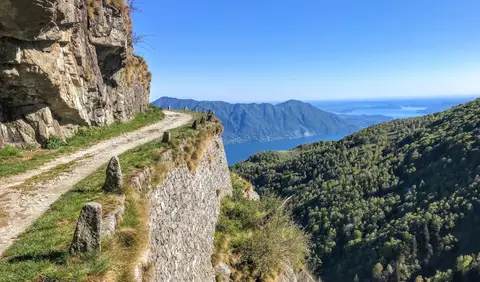 PiedmontCima di Morissolo and the Linea Cadorna fortificationsA summit dropping sheer to Lake Maggiore, just 30 minutes' walk away, with a maze of Linea Cadorna tunnels.
- Grade
- T
- Time
- 1:30h
- Distance
- 3.5km
- Ascent
- 170m
- Rating
- 8/10
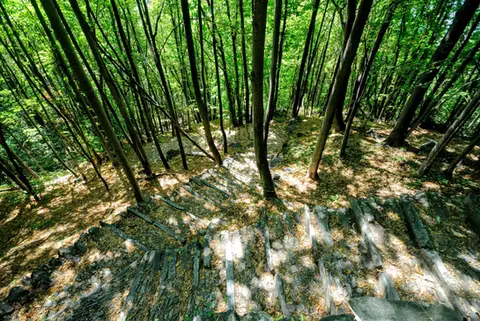 ValchiavennaAcquafraggia Falls, Savogno and DasileA loop around the Acquafraggia Falls: ladders, pools, Lilliputian villages and old mule tracks.
- Grade
- T
- Time
- 3:00h
- Distance
- 5.5km
- Ascent
- 620m
- Rating
- 8/10
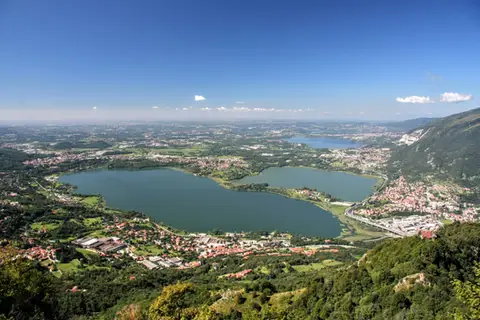 Lake ComoThe protected path on Monte BarroA slightly more entertaining alternative to the normal ascent of Monte Barro.
- Grade
- EE
- Time
- 2:00h
- Distance
- 3.5km
- Ascent
- 310m
- Rating
- 7/10
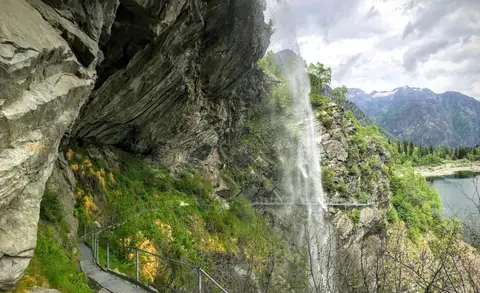 PiedmontThe Valle Antrona loop: Lago Antrona and Lago di CampliccioliA short hike around the lakes of Antrona and Campliccioli, in the lower Valle Antrona.
- Grade
- T
- Time
- 3:00h
- Distance
- 10km
- Ascent
- 400m
- Rating
- 7/10
Questions
The answers come from the hike pages listed here.
Which one is the best, in your view?
Cima di Morissolo and the Linea Cadorna fortifications and Acquafraggia Falls, Savogno and Dasile, all rated 8 out of 10.
Which one is the easiest?
Cima di Morissolo and the Linea Cadorna fortifications: grade T, 1:30 hours of walking and 170 metres of ascent.
How long do these hikes take?
From 1:30 to 3:00 hours of walking, with ascents between 170 and 620 metres.
More guides
Other lists that share some of these hikes.