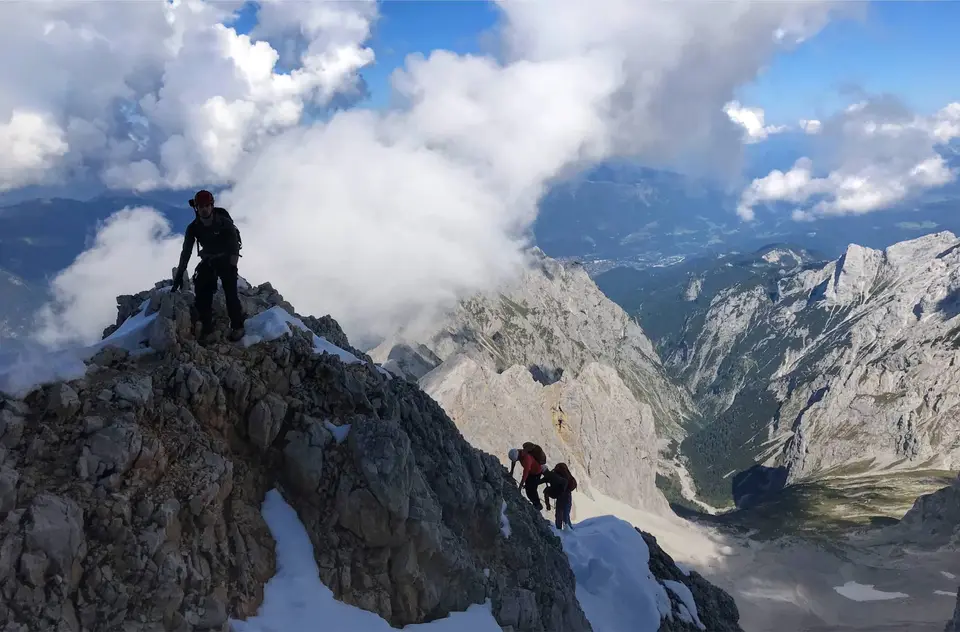
A few minutes from the summit of the Zugspitze, on the Höllental via ferrata (Höllental Klettersteig). You get here after more than 8 hours of walking, more than 3 of them on the via ferrata.
Germany, despite having a tiny slice of the Alpine arc, still enjoys some final bursts of Dolomite-like rock that erupt into truly iconic peaks and towers. Particularly iconic is the Zugspitze, the “roof of Germany”, its highest point. Amusingly, it does not even reach 3,000 metres, but it is no lesser for that, with its mighty amphitheatre of vertical walls that recall, in shape and size, the great rock dome of Monte Pelmo, a few dozen kilometres to the south.
Good to know about the Bavarian Alps
The first documented ascent of the Zugspitze dates from 27 August 1820, when the Bavarian lieutenant and surveyor Josef Naus reached the summit with his assistant Maier and the guide Johann Georg Tauschl, although an eighteenth-century map found in the German Alpine Club's archive in 2006 suggests an earlier ascent. Further north, the Herzogstand has a royal history: the Wittelsbachs built a hunting lodge here in 1857, and Ludwig II had his royal house put up in 1865, with a bridle path climbing to it from the Kesselberg pass. The building burned down in 1990 and nothing of the original survives, but the path and the view over the Walchensee are still the ones the king saw.
For the Zugspitze via ferrata, graded B/C, you need a harness meeting EN 12277, a helmet meeting EN 12492 and a via ferrata set with an energy absorber meeting EN 958; the A to E scale describes how hard the moves are, not how long the route is, and a long B/C like this one asks above all for stamina. On sleeping outdoors Bavaria is restrictive: wild camping in a tent is broadly forbidden, while the German Alpine Club points out that a planned bivouac, for one night and without a tent, is tolerated outside protected areas where it is expressly banned. The rules vary from area to area, so it is worth asking the authority that manages the land.
The hikes
By our rating, highest first. Browse them as photographs, as a list with all the numbers or on the map.
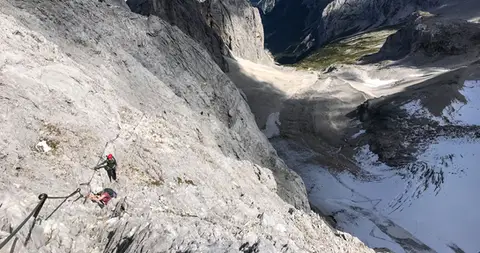 GermanyZugspitze Via Ferrata / Klettersteig10 hours of walking, 4 of them on via ferrata, and over 2200 metres of ascent, to reach the highest peak in Germany.
- Grade
- B/C
- Time
- 7:30h
- Distance
- 11km
- Ascent
- 2,180m
- Rating
- 10/10
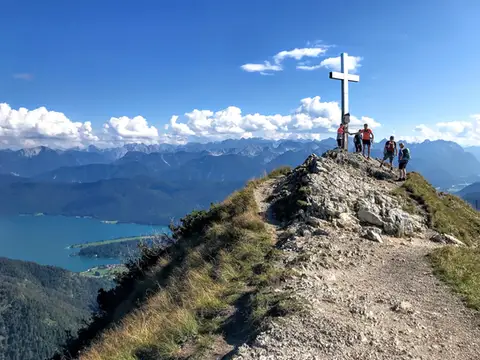 GermanyHerzogstand and Heimgarten loopTwo mountain lookouts above the German plain and the Walchensee.
- Grade
- E
- Time
- 4:30h
- Distance
- 10km
- Ascent
- 360m
- Rating
- 7/10
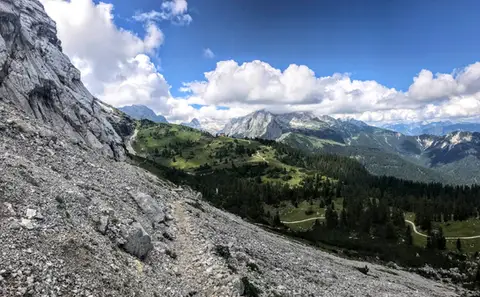 GermanyThe Wettersteinwand balconyFrom Garmisch to Mittenwald, through gorges, Dolomite-like scenery and picture-postcard lakes.
- Grade
- E
- Time
- 12:00h
- Distance
- 32km
- Ascent
- 1,940m
- Rating
- 7/10
Questions
The answers come from the hike pages listed here.
Which one is the best, in your view?
Zugspitze Via Ferrata / Klettersteig, which we rated 10 out of 10.
Which one is the easiest?
Herzogstand and Heimgarten loop: grade E, 4:30 hours of walking and 360 metres of ascent.
How long do these hikes take?
From 4:30 to 12:00 hours of walking, with ascents between 360 and 2,180 metres.
More guides
Other lists that share some of these hikes.